

Curriculum
Jolly Phonics
Jolly Phonics Step 1:
The Foundation of Reading and Writing
Step 1 introduces children to the first set of Jolly Phonics letter sounds while establishing the five core skills that underpin the entire program. Children learn the sounds through a multisensory, active approach, connecting what they hear, say, see, and do.

Across 14 weeks, Explorers develop five foundational literacy skills:
Learning the Letter Sounds
Children are introduced to the 42 main letter sounds of English, not simply the 26 letter names of the alphabet. The sounds are taught in a carefully designed sequence that allows children to begin reading words quickly. Each sound is associated with a memorable action and story, helping children create strong links between the sound and its corresponding letter formation.
Learning Letter Formation
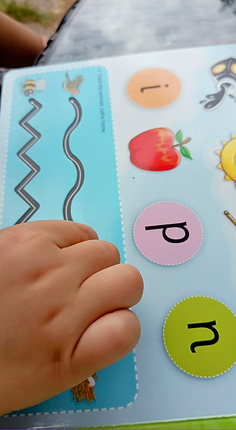
As each sound is introduced, children learn how to form the corresponding letter or letters correctly. The physical act of writing reinforces the sound–symbol connection and develops the motor patterns needed for fluent handwriting.
Blending for Reading
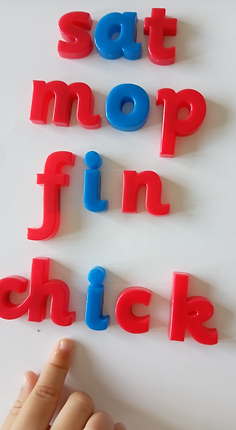
Children learn to blend individual sounds together to read words. For example, /s/ /a/ /t/ can be blended to read sat. Blending is explicitly taught from the beginning, giving children a strategy for decoding unfamiliar words rather than relying on memorization or pictures.
Identifying Sounds in Words for Spelling
Children learn to hear and identify the sounds within spoken words and represent those sounds with letters. This process, often called segmenting, develops the foundation for spelling. For example, children learn to listen to pin, identify /p/ /i/ /n/, and select the appropriate letters.
Tricky Words
Children are introduced to words that cannot be fully decoded using the sound patterns they have learned. These tricky words are taught explicitly, helping children recognize words such as I, the, and was and understand which parts are regular and which are unusual.
The 42 Sounds
Rather than teaching the alphabet in traditional A–Z order, Jolly Phonics introduces the 42 main sounds of English in seven groups. The sequence is designed to give children the ability to begin blending words as early as possible.
At The Reading Lodge, each group maps directly to one leg of The Ascent, the seven-stage journey that gives every Explorer a clear sense of progress and momentum.

Why Step 1 Is So Important
The power of Step 1 is that these five elements are taught together rather than as isolated skills. A child hears a sound, says it, performs an action, sees its written representation, forms the letter, and then immediately begins using the sound to read and spell words.
This creates a continuous pathway:

By the end of Step 1, children are not simply memorizing letters. They are beginning to understand the alphabetic principle: that the sounds in spoken language can be represented by written symbols—and they have the foundational tools needed to become independent readers and writers.
The Reading Lodge is built on Jolly Phonics, one of the world’s most widely used systematic phonics programs
Developed by educators Sara Wernham and Sue Lloyd and published by Jolly Learning Ltd., Jolly Phonics is used in classrooms in more than 150 countries and has been the subject of research examining its impact on early literacy.
What makes Jolly Phonics distinctive is not simply what children learn, but how they learn it: explicitly and systematically.
Jolly Phonics: Reading and Writing: Two Sides of the Same Process
A unique feature of Jolly Phonics is that reading and writing are taught simultaneously. Children learn to decode, blending sounds to read words, and to segment, breaking words into their individual sounds to spell and write them. Rather than treating reading and writing as separate skills, Jolly Phonics develops them together from the very beginning.
This two-way approach gives children repeated opportunities to connect sounds, letters, and written words.
When a child reads sat, they move from print to sound through decoding. When they hear sat and write it, they move from sound to print through segmenting and encoding. Each direction reinforces the other, helping children build increasingly secure connections between the phonological and orthographic systems.
Research supports the importance of this reciprocal relationship.
Systematic phonics instruction has been shown to improve both word reading and spelling, while studies of orthographic learning suggest that spelling can place particularly strong demands on attention to the identity and sequence of letters. In one study, children who practiced spelling showed stronger orthographic learning than children who practiced reading alone.
The result is more than simply learning to recognize letters.
Children are learning to analyze words, manipulate sounds, map sounds to letters, and reproduce those patterns in writing. By engaging these complementary processes repeatedly and explicitly, Jolly Phonics helps children develop the foundations for increasingly automatic reading and accurate spelling.
In other words, children don't just learn to read words—they learn how words work.

WHY IT WORKS: The Research
The evidence supporting systematic phonics instruction is among the strongest in the field of early reading research.
The landmark Clackmannanshire study (Johnston & Watson, 2004, 2005) followed approximately 300 children over seven years and found that children taught through a synthetic phonics approach made strong gains in reading and spelling. Importantly, their progress continued over time, with reading performance reaching well above age expectations by the end of the study. A major review published in Psychological Science in the Public Interest (Castles, Rastle, & Nation, 2018) likewise concluded that systematic phonics is an essential component of effective early reading instruction. Research and reviews such as these have helped shape literacy guidance and policy in the United Kingdom and internationally. For children ages 4–6, how instruction is delivered matters, too. Young children learn through active engagement with their environment. Pairing speech and sound with movement, visual information, and hands-on experiences gives children multiple ways to connect with and remember new information. That is the strength of the Jolly Phonics approach. When a child hears a sound, says it, sees its corresponding letter, makes an associated action, and uses that sound to build words, learning is reinforced through multiple pathways. Reading becomes something children do, not simply something they are told about. At The Reading Lodge, we bring this evidence-based approach to life through purposeful, playful, hands-on instruction designed specifically for young learners.
What Jolly Phonics Looks Like
at The Reading Lodge

Learning to read should feel exciting, not like work.
At The Reading Lodge, children learn to read through a carefully designed combination of movement, music, hands-on learning, and explicit instruction. Every session is active, purposeful, and joyful, while following the systematic structure of Jolly Phonics.
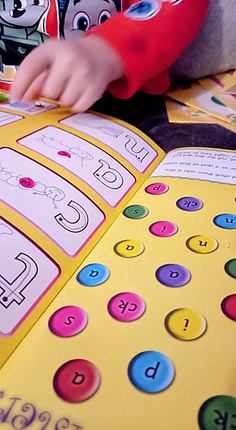
Each of the 42 letter sounds is introduced with its own memorable action and song. When children learn /s/, they move their arm like a snake while saying the sound. For /a/, they pretend an ant is crawling up their arm. These simple actions give children something they can see, hear, say, and do, creating strong memory pathways for learning.
And your child won't just be sitting at a table.
Our Explorers move, sing, listen, talk, touch, write, blend sounds, build words, and play purposeful literacy games. Short, varied activities keep young minds engaged while giving children repeated opportunities to practice and master new skills.

Reading and Writing Grow Together
From the very first session, children learn that sounds and letters belong together. As they learn a new sound, they also begin learning how to form its letter correctly. Pencil grip, letter formation, listening for sounds, blending, reading, and spelling are developed together rather than taught as disconnected skills.
This matters because learning to read isn't simply about memorizing letters. Children need to understand the relationship between what they hear, what they see, and what they write. Jolly Phonics gives them a clear, systematic pathway for making those connections.

Serious Learning. Joyful Experience.
There is a lot happening beneath the fun.
Every song, action, game, movement, and writing activity has a purpose. Children are developing phonemic awareness, sound recognition, blending, segmenting, decoding, spelling, handwriting, vocabulary, and confidence, all while participating in activities that feel natural and enjoyable.
Our goal is for children to leave each session thinking, “That was fun!”
Meanwhile, we know they have been doing something much more important: building the foundations they need to become successful, confident readers and writers.


